


Santiago Bose’s (1949–2002) mixed-media practice integrates indigenous motifs, painted imagery, and colonial photography to assert the artist’s perspective on the postcolonial moment. Born in Baguio, Philippines (as a native but not to the indigenous Cordillera people) Bose critiqued colonialism and its erasure of indigenous culture as well as his contemporary moment’s apathy towards these non-Christian communities. The artist’s work perceives Baguio as ‘American’ since the city’s architect was Daniel Burnham, a prominent American urban designer who drafted the 1909 Plan of Chicago. From the perspective of Baguio as American and Filipino, Bose’s art emerges from a third space, a liminal suspension conducive to the formation of Filipino identity located within colonial legacy, local community, and national culture. This essay investigates his collaged artworks Carnivores of Session Road (2002) and Juan Tamad Series (2000) through the critical theories of Stuart Hall, Homi Bhabha, and Frantz Fanon to frame postcolonial Filipino art within the global discourse and identity-building rhetoric. Bose’s mixed media depictions of the temporal palimpsest of Filipino culture contribute to a postcolonial identity through the hybridized space of Baguio and its local communities.
Carnivores of Session Road is a mixed media collage that combines black and white photography with painted imagery. Bose uses color to draw the viewer’s eye to the center of the composition where three Igorot caricatures support Kentucky Fried Chicken’s “Colonel Sanders” on a palanquin. An obscured “Ronald McDonald” stands behind the other figures, his face covered by the underside of the wooden seat. These fast-food moguls represent the American colonial authorities as icons of excess and capitalist greed and are paraded around Baguio to survey the site of their ‘summer capital.’ All three of the Igorots are depicted in a cartoonish manner with exaggerated features meant to present them as ‘savage’ or ‘primitive’ with oversized teeth and protruding jaws. While Bose has rendered the characters as they are perceived by the colonial gaze, he endowed them with the luxuries of the postcolonial moment with running shoes and landline telephones. In the background, a collage of photographs of Baguio (after the site has been laid with concrete and packed with shoppers and their cars) draws attention to the camera as a colonial tool used to survey the land and peoples. Bose investigates these photographs in his work as politically charged with the colonial agenda.1 These layered photographs foreground massive pine trees that reach towards the sky to remind the viewer of the altitude of these highlands.
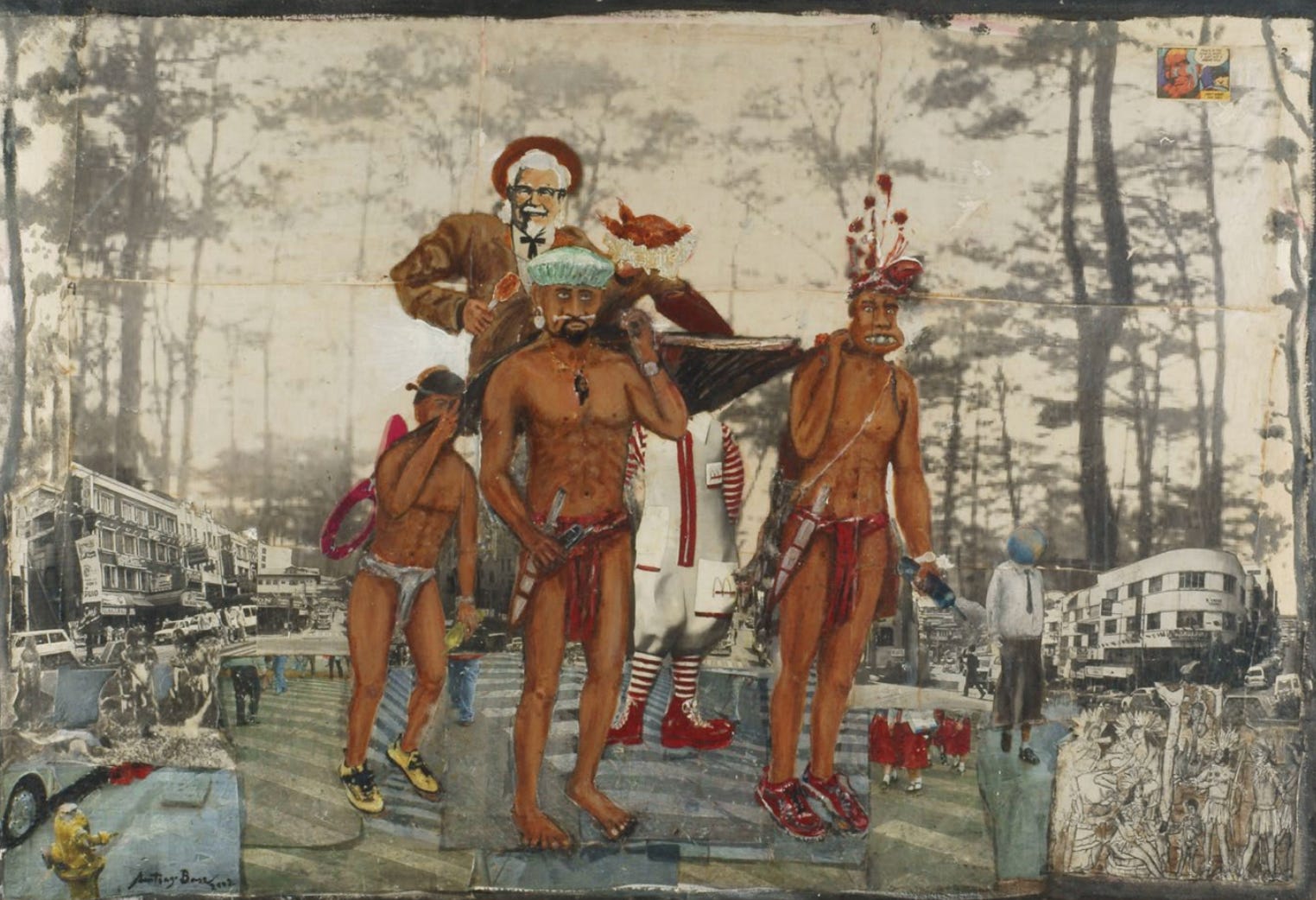
Through the colonial photographs and indigenous caricatures, Carnivores of Session Road plainly references the asymmetrical power dynamic between ‘the West’ (colonial United States) and ‘the Rest’ (colonized islands of the Philippines). Cultural theorist Stuart Hall’s writings that discuss the history, complexity and discursive power in these terms “the West” and “the Rest.” While it is problematic to automatically identify the Philippines as peripheral, these designations can be used to understand the operative social and ideological differences between the figures in the work. The term “the West” is a historical construct, an expression of a developed society that can be described as industrial, urban, capitalist, secular, and modern.2 This concept of “the West” serves as a system of representation with many theoretical functions. Primarily, this idea serves as an evaluative tool that has been employed to rank different societies in a global hierarchy, a means to categorize and provide a model of comparison.3 Historically, ‘Western’ national cultures were constructed in contrast against others– their understanding of their own culture was shaped both by internal factors and external differences. All communities deemed to be non-Western, lesser, or ‘primitive,’ then, were assigned to the category of “the Rest”– a discursively related Other composed of heterogeneous cultures and geographies across the Americas, Africa, Oceania, and Asia.4 While this system of representation is inherently problematic as it oversimplifies, homogenizes, and polarizes, it reflects the epistemology about the perception of the ‘Western’ Self and ‘the Rest’ as Other.5
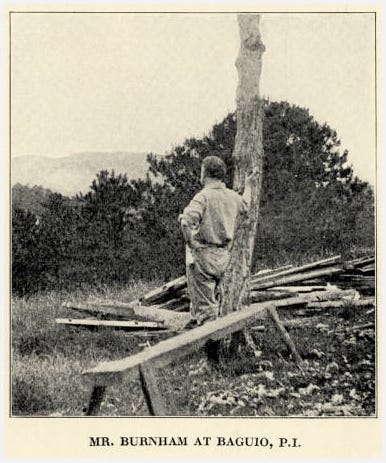
Identifying the United States as ‘the West’ and the Philippines as part of ‘the Rest’ emphasizes the need for a critical perspective about these designations to question why these labels exist in the postcolonial moment and how they can be reconsidered. In Bose’s practice, this critique appears in his work through the site of Baguio and its connections to the American empire. In the colonial era, a way that the United States government exercised control over their colony of the Philippines was through landscape imperialism, importing a Western neoclassical aesthetic to the mountains of Southeast Asia. This American plan for the mountain community coincided with the City Beautiful movement and was drafted by Chicago architect Daniel Burnham, who envisioned a white city paradigm with a grid system of streets and radial boulevards, parks, and malls.6
Burnham arrived in the Philippines in December 1904.7 In that same year, the Manila Times reported on a ten-square mile fence that was reserved for the Baguio site and construction began sometime shortly after.8 Burnham was excited by the idea of designing Baguio as a site of ‘civilized perfection’ in the ‘savage overseas outpost’ and drafted the layout for free. Burnham’s preferred medium (a new innovation), concrete, allowed the United States to reshape the hostile, tropical conditions of the Filipino colony on the basis of the civilizing mission.9 Their modern vision for Baguio was central to the American venture in the need for a familiar, ordered site that provided refuge from the politics, heat, and humidity of Manila.10
Architectural historian Diana Martinez studies this American venture by the use of material as a method in her term of “concrete colonialism.” She writes that concrete was used as a weapon of colonization that transformed the indigenous peoples into instruments of production and reduced Filipinos to a measurable and mastered object.11 The modernization of the site and development of the white city paradigm through this aesthetic landscape served to erase the conditions of production (exploitative labor) and attempted to naturalize order (American over Filipino) at moments of political transition.12 Carnivores of Session Road engages with these events before the land was gridded and construction began, drawing on the history of the site as it is becoming colonial American. The structural and architectural violence can be seen in Bose’s work, namely the perspective of this ‘civilizing mission’ on the indigenous as they are represented through caricatures. As such, Bose engages Baguio as an Other space, designed by an empire and built by its subjects, refugees, and exiles.13
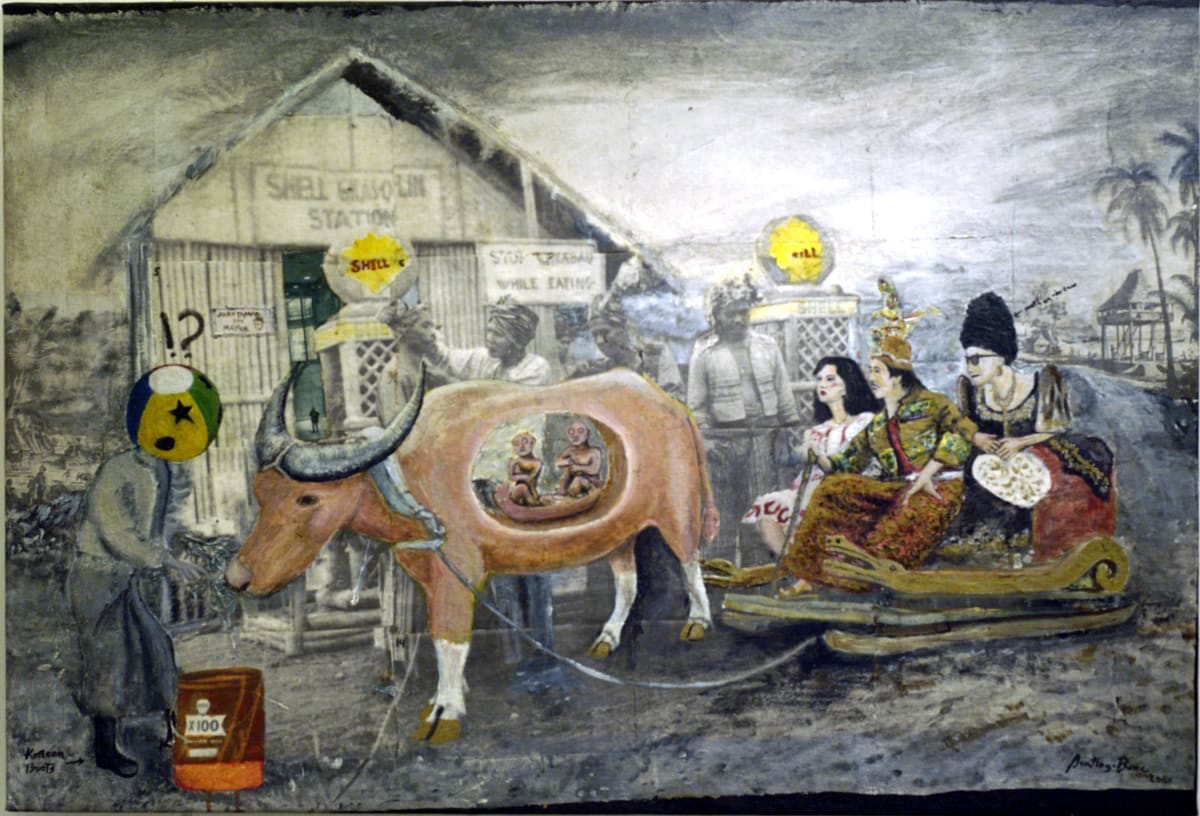
Another work which engages themes of Baguio as (an)Other space is Juan Tamad Series. This mixed media assemblage unites painted images, black and white collaged photographs, and text–used to indicate important figures in the scene–with references to modern Filipino culture. The name of the artwork is referenced in a posted sign on the side of the gas station which reads, “Juan Tamad for Mayor.” Juan Tamad was a local embodiment of the trickster archetype, a lower class character who outwitted his powerful enemies in a reflection of the highly divided colonial Filipino society.14
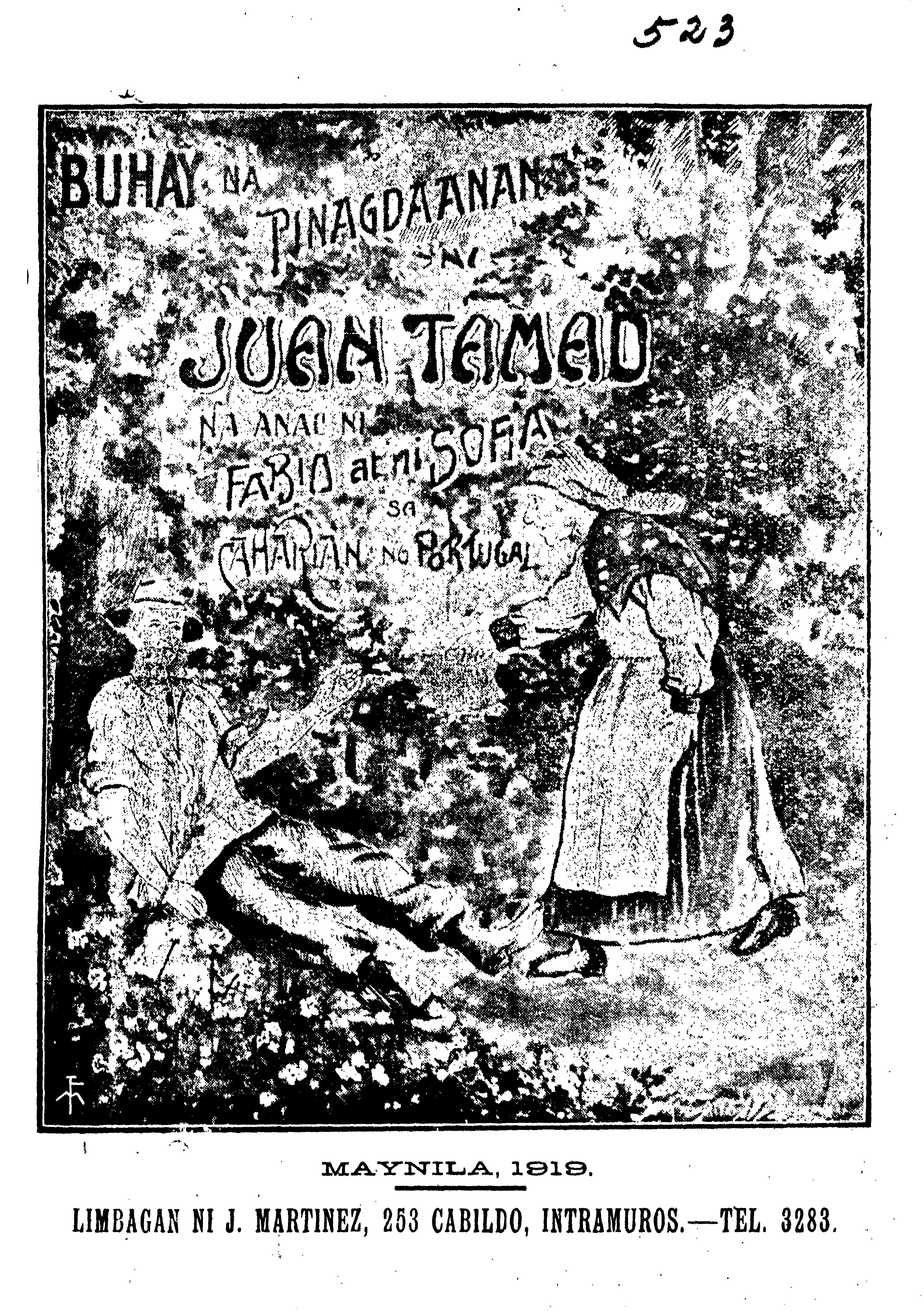
The trickster hero appears in Filipino media in folktales, children’s stories, films, and television series. His character is politically charged and representative of community resilience in the face of oppressive systems.15 The humorous and lazy character can be understood through the Filipino people’s desire to escape Spanish colonial enslavement as a subversion of the indolent indio– a form of mimicry turned mockery of the colonial perception of the ‘lazy native.’16 Bose’s reference to the character of popular culture reflects the use of Filipino folk symbols in his work, a choice that initiates visual dialogue with the local community rather than catering to the Western viewer.
The main focus of the work is painted in color where a carabao (national animal of the Philippines) is fed grass at a Shell gas station. The image of the gas station perhaps references the artist’s childhood– his uncle was a businessman who built the first gas station in Baguio.17 The carabao’s side is carved out and protects two figurines on a boat in reference to the Manunggul Jar from Palawan.18 The carabao pulls a sled carrying three figures, a husband and wife seated in the front and the mother-in-law seated in the back–the latter labelled with text and an arrow. The husband is dressed in traditional Maranao clothing with a malong wrapped around his legs, a baju shirt, and dyukit headcovering– the ornamentality of these textiles indicate that he is an elite figure on the level of a chief or datu.19 In contrast, the mother-in-law holds an alampay woven fan and wears Spanish colonial era gold filigree jewelry around her neck and ears with a Maria Clara dress and wayfinder sunglasses, all signifiers of the modern Filipino.
Behind the sled and three figures are black and white photographs of indigenous Maranao people in similar attire to that of the husband. These four men converse among themselves while looking at the scene before them, perhaps in suggestion of their status as relinquished to observers rather than participants in the contemporary times of the country due to various biased power structures. While the husband and indigenous figures wear the same clothes, the husband is depicted as a focal point in color and controls the carabao sled for his wife and nanay (mother/mother-in-law). The difference between the men, it appears, is that the husband is a modern man in tune with his cultural heritage, and the photographed indigenous men are positioned in the past as his predecessors. However, an alternative reading suggests that they are all contemporary and that the photographed indigenous are from a community that chooses not to associate with metropolitan convenience. Either way, the work engages the site of Baguio as a space of possibility where culture and tradition throughout history are collapsed onto a singular postcolonial picture plane.
Bose’s engagement with the Baguio mountainscape transforms the city into a worldly, cosmopolitan site, superseding the flatness of ethnicity and indigeneity.20 This experience of Baguio as a site of otherness places the work in a liminal state, suspended between a multitude of categorizations: ‘the West’ and ‘the Rest,’ native and indigenous, American and Filipino, and folk and international. As such, Carnivores of Session Road and Juan Tamad Series evade strict classifications, deferred to the “third space” of Homi Bhabha’s postcolonial theory. To use Bhabha’s writing on the origin and definition, “the non-synchronous temporality of global and national cultures opens up a cultural space – a third space.”21 The non-synchronous temporality in Bose’s works is evident, two mixed media coalescences of past and present through photography and painted image; Carnivores of Session Road and Juan Tamad Series exist within this third space. Bhabha’s theory continues where the third space “constitutes the discursive conditions of enunciation that ensure that the meaning and symbols of culture have no primordial unity or fixity; that even the same signs can be appropriated, translated, re-historicized, and read anew.”22 Bose’s use of local symbols in his work engages with these ideas where the use of the fast food mascots in Carnivores of Session Road or the Manunggul Jar in Juan Tamad Series posit that meaning is malleable and contextual. In the case of the KFC and McDonald’s figureheads, these symbols betray their assigned meaning for American convenience and sustenance to be translated to international symbols of capitalism and colonial exploitation. The Manununggul Jar is read anew as part of the history that literally drives (placed in the belly of the carabao as an engine powers a car) Filipinos forward to their next destination. Further, the character of Juan Tamad is re-historicized from a Spanish anticolonial figure to an American anticolonial allusion.
Bose revealed that his use of symbols is part of his practice of connecting to the community and making art that Filipinos understand.23 The main investigations across Bose’s oeuvre can be understood in three categories: the relationship between colonial master and native subject, talismanic systems that disrupt positivist histories through belief and miracle, and temporal passing.24 All three of these investigations can be seen in Carnivores of Session Road and Juan Tamad Series through the use of photographs and painting in his artworks that reveal the tensions between colonizers and colonized and the palimpsest of reality and history as layered.25 The photographs and painted images regard the passage of time and subvert linear expectations in an assemblage of past and present into a singular moment. Additionally, his works show a deep awareness of the problems surrounding indigenous communities in the postcolonial moment and the harm that comes from romanticizing their culture. To combat these issues, Bose maintained a certain cognitive distance from the Igorots in his own community and made his positionality clear.26
While Bose was born in Baguio and lives as a native, his parents were Ilocano and affiliated with the Tinggian ethnic group from Abra– he made this ancestry apparent in his work and his own writings.27 His interest in the Igorots of Baguio was highly collaborative and his engagement with indigenous Filipinos extended past the groups of where he lived to communities in the Southern Philippines such as the Maranao (evidenced by the attire in Juan Tamad Series).28 In addition to engaging in the daily lives of various ethnic groups and indigenous communities, Bose served the public and his fellow artists through the founding of the Baguio Arts Guild in 1986.29 The BAG modeled their work after the indigenous collective approach rather than Western individualism, looking to the rice terraces of the region for inspiration as a community-built monument (rather than one that was built through enslavement or exploitation such as the Benguet Road or site of Baguio).30 Looking at Bose’s work about Baguio through the perspective of native-grown inspiration of Bhabha’s third space positions Carnivores of Session Road and Juan Tamad Series as active works in the discourse that search for a ‘Filipino culture’ from within, rather than its relation to the West or colonial powers. Since the art and community practices operate within the third space, they give meaning to culture and contemporary identity– not colonially Spanish, territorially American, or partially Southeast Asian, but rather a collage of histories and communities that are exactly: Filipino.
Bose’s struggle to work from the space of Otherness in the pursuit of identity in the postcolonial world relates to Frantz Fanon’s critical analysis in Wretched of the Earth (1961). The theoretical framework can be applied to the Filipino case as a marginalized culture with a history of degradation. Fanon states that every generation must resist the work of colonialism and contribute to the struggle carried by their predecessors. The new generation must recognize the valiant efforts of the previous and frame their perceived silence on the global stage as the result of a different international situation since it takes more than one voice to claim victory.31 Bose’s writings reflect this passion for change where he states,“I am rebelling against my own indifference. I am rebelling against the idea that the world is the way it should be and there is nothing we can do about it.”32 Fanon charges native intellectuals and artists to take up this struggle of their ancestors, a burden that Bose shoulders through his use of folk symbols in his work, his dialogue with indigenous peoples in the region, and his service to other artists and the community in the BAG. Here, Bose is interpreted as not only an artist but an intellectual, an author who wrote multiple articles, gave lectures, and conducted interviews about his work and revolutionary mindset.33 In this way, Bose’s practice aligns with Fanon’s theories that native intellectuals explored their cultural past and looked to the precolonial era to combat the colonial agenda that sought to distort, disfigure, and destroy the past of their colonies.34 Carnivores of Session Road presents Igorots, a community that predates colonialism and outlives attempts at erasure. Juan Tamad Series displays the Manunggul Jar, an ancient artifact that evidences a prehistoric past with concepts of the soul and afterlife.
Santiago Bose’s contemporary works, Carnivores of Session Road and Juan Tamad Series serve the postcolonial discourse of art history through entangled forms, histories, and critical theories. Operating from the third space based in the Otherness of Baguio as both colonial American and modern Filipino, Bose’s works presents a nonlinear representation of history through mixed media collage. Since the artworks function in the third space, they have the capacity to create new meaning and define new aspects of Filipino identity and culture as hybrid and international rather than Othered and non-Western. Bose’s critical explorations about temporality, coloniality, and otherness places his art, in Fanon’s view, as preceding the contemporary Filipino artists who will continue his struggle for identity and resistance against the aftermath of colonialism. Carnivores of Session Road and Juan Tamad Series engage the Filipino viewer with icons of folk culture that are not immediately recognized by the Western audience, an interaction that privileges the Filipinos in a ground up perspective rather than the international viewer in a top down model. The artworks’ reference to folk symbols, native communities, and modern conveniences reflect the nation’s complicated engagements with the globalized world (namely that of a metropolitan Chicago) and the need to investigate the internally Othered histories of the precolonial and the indigenous in the pursuit of a ‘true’ decolonized Filipino identity.
Jonah Sanderson is an emerging curator and art historian whose practice centers Southeast Asia and Filipino visual culture. As an MA student in SAIC’s Modern/Contemporary Art History program, their practice explores Filipino art through modern Filipinism, post-colonial identity, and decoloniality in the global contemporary context.
Endnotes
Alice Guillermo, “Santiago Bose: His Works and Words,” in In Memory of a Talisman: An Exhibition of Works by Santiago Bose (National Commission on Culture and the Arts, 2004), 24.
Stuart Hall, “The West and the Rest: Discourse and Power,” in Formations of Modernity, edited by Stuart Hall and Bram Gieben (Open University, 1992), 277.
Hall, “The West and the Rest,” 277.
Hall, “The West and the Rest,” 279.
Hall, “The West and the Rest,” 280.
Patrick Flores, “From Hill to the World,” in Santiago Bose: Painter, Magician, edited by Patrick Flores (ArtAsiaPacific, 2025) 9.
Diana Jean S. Martinez, Concrete Colonialism: Architecture, Urbanism, and the US Imperial Project in the Philippines (Duke University Press, 2025), 58.
Kirsch, “Aesthetic Regime Change,” 340.
Martinez, Concrete Colonialism, 7–8. At the time, the Philippines was seen as the stabilizer for the American economy. If the government could not gain capital through increased exports, they would stimulate economic growth through their own development projects on its land. Martinez, Concrete Colonialism, 33.
Kirsch, “Aesthetic Regime Change,” 324.
Martinez, Concrete Colonialism, 47.
Kirsch, “Aesthetic Regime Change,” 319.
Flores, “From Hill to the World,” 9.
Soledad S. Reyes, “The Komiks and Retelling the Lore of the Folk,” Philippine Studies: Historical & Ethnographic Viewpoints 57, no. 3 (2009): 395, https://www.jstor.org/stable/42634017.
Laurence Marvin S. Castillo, “The (Anti)Colonial ‘Awit’ of Juan Tamad Didacticism and Subversion in a Colonial Metrical Romance,” Philippine Studies: Historical & Ethnographic Viewpoints 65, no. 3 (2017): 358, https://www.jstor.org/stable/26621923
Castillo, “The (Anti)Colonial ‘Awit,’” 381.
Guillermo, “Santiago Bose,” 27.
The Manunggul Jar from the Manunggul Cave at Lipuun Point in Palawan is an earthenware artifact dated 890–710 BCE and was used to protect the remains of the dead. The jar displays an unusual sculptural quality for the period with two figures seated on a boat with a human face on its prow, a representation of two bodies rowing their way to the afterlife. “Manunggul Jar,” Cultural Center of the Philippines Encyclopedia of Philippine Art, accessed 8 March 2026, https://epa.culturalcenter.gov.ph/3/82/2227/.
“Making a Landscape (Tubular Garment),” Mapping Philippine Material Culture, accessed 9 March 2026, https://philippinestudies.uk/mapping/items/show/29333.
Flores, “From Hill to the World,” 13.
Homi Bhabha, “How Newness Enters the World,” in The Location of Culture (Routledge, 1994), 218.
Homi Bhabha, “The Commitment to Theory,” New Formations 5, (1988): 21.
Guillermo, “Santiago Bose,” 19.
Flores, “From Hill to the World,” 23.
Guillermo, “Santiago Bose,” 24.
Ibid, 20.
Ibid, 10.
Ibid, 12.
Midori Yamamura, “Asia’s Cold War and Environmental Devastation: Kidlat Tahimik and Roberto Villanueva’s Neo-Indigenous Response in the Philippines and Beyond,” in Visual Representations of the Cold War and Postcolonial Struggles: Art In East and Southeast Asia, edited by Midori Yamamura and Yu-Chieh Li (Routledge, 2021), 98.
Yamamura, “Asia’s Cold War,” 99.
Frantz Fanon, “On National Culture,” in The Wretched of the Earth, translated by Constance Farrington (Grove Press, 1963), 207.
Santiago Bose, “Decentering from Indifference: Fragmented Notes on NYC and Baguio City,” in Espiritu Santi, edited by Krip Yuson (Water Dragon Incorporated, 2004), 120.
Guillermo, “Santiago Bose,” 5.
Fanon, “On National Culture,” 210.